If you live in North Carolina and struggle with soggy grass, standing water, or muddy areas that never seem to dry out, clay soil is likely the culprit. One of the most common questions D & L Landscape Pros hears from homeowners in Monroe, South Charlotte, and surrounding areas is: what’s the best drainage solution for clay soil?
Clay soil is notoriously difficult to manage, and generic drainage advice often falls short. The right solution depends on how clay behaves, how water moves across your property, and how drainage, grading, and landscaping work together. Understanding these factors is key to fixing the problem long-term.
Why Clay Soil Causes So Many Drainage Problems
Clay soil is made up of extremely fine particles packed tightly together. Unlike sandy soil, which allows water to pass through easily, clay resists absorption. When heavy rain hits, water has nowhere to go — so it sits on the surface.
In North Carolina, this problem is amplified by frequent storms and seasonal downpours. D & L Landscape Pros regularly works with homeowners whose yards look fine during dry weather but turn into puddled, muddy messes after rain.
Clay soil also compacts easily. Foot traffic, lawn equipment, pets, and even time itself compress the soil further, making drainage issues progressively worse. That’s why solving drainage problems in clay soil requires more than surface-level fixes.
Why There’s No One-Size-Fits-All Drainage Solution
Many homeowners search for “the best drainage solution” hoping for a single answer. In reality, effective drainage in clay soil depends on several factors, including:
- Yard slope and grading
- Location of low spots
- Proximity to the home or hardscapes
- Amount of runoff from roofs and neighboring properties
D & L Landscape Pros approaches drainage as a system, not a standalone product. The best solution is usually a combination of methods designed specifically for North Carolina soil and rainfall patterns.
Improving Drainage Starts With Proper Grading
Before installing drains, it’s critical to understand how water flows across your yard. Poor grading is one of the most common reasons clay-soil yards stay wet.
If your yard is too flat or slopes toward your home, water naturally collects instead of draining away. D & L Landscape Pros evaluates grading early in the planning process to ensure water moves where it should.
In some cases, correcting grading alone can significantly reduce standing water. In others, grading sets the foundation for more advanced yard drainage solutions that manage excess water below the surface.
French Drains: A Popular Solution for Clay Soil
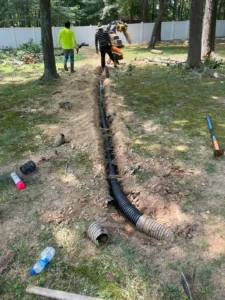
One of the most effective drainage options for clay soil is a French drain — when installed correctly. French drains collect water underground and redirect it away from problem areas, preventing surface pooling.
However, French drains aren’t automatically the right choice for every yard. Depth, slope, pipe placement, and discharge location all matter. D & L Landscape Pros often installs French drains as part of a broader drainage plan that includes grading and runoff management.
Homeowners comparing options often benefit from understanding how French drains differ from other approaches and when each method makes sense for their property.
Surface Drains vs. Subsurface Systems
In some situations, surface drains can help manage excess water, especially in areas where runoff collects quickly. However, surface drains alone often struggle in clay soil because water doesn’t move through the ground efficiently.
Subsurface systems, like French drains, are typically more effective long-term. D & L Landscape Pros designs systems that account for how water behaves beneath the surface, not just what’s visible after a storm.
Addressing drainage below ground is often the key to preventing recurring issues discussed in common drainage damage scenarios.
Soil Improvements Can Support Drainage — But Rarely Solve It Alone
Many homeowners try to fix clay soil by adding sand, compost, or topsoil. While soil amendments can improve structure over time, they rarely solve drainage issues by themselves.
In fact, mixing sand incorrectly with clay can make drainage worse. D & L Landscape Pros evaluates whether soil improvements make sense as a supporting strategy rather than relying on them as a primary fix.
Understanding soil health and moisture retention helps explain why drainage solutions must work with clay soil’s limitations, not against them.
Managing Roof Runoff Is Critical in Clay Soil Yards
Clay soil struggles to absorb even moderate rainfall — add roof runoff, and the problem escalates quickly. Downspouts that discharge near the home or into flat areas can overwhelm soil and create persistent wet zones.
D & L Landscape Pros often incorporates runoff redirection into drainage planning, ensuring roof water is safely carried away from vulnerable areas. This step is especially important for protecting foundations and preventing erosion near structures.
Why DIY Drainage Fixes Rarely Work in Clay Soil
Quick fixes like shallow trenches, gravel-filled holes, or store-bought drains often fail in clay soil. Water may temporarily disappear, only to resurface elsewhere.
D & L Landscape Pros frequently works with homeowners who tried DIY solutions first and discovered:
- Trenches collapse or clog
- Gravel pits fill with sediment
- Water simply moves to a new low spot
Professional drainage systems are engineered to handle North Carolina’s rainfall volume and soil behavior — something DIY methods rarely account for.
How Drainage Protects Hardscapes and Landscaping
Poor drainage doesn’t just affect lawns. Excess water can undermine patios, walkways, and retaining features over time. Clay soil that stays saturated expands and contracts, causing shifting and settling.
By integrating drainage into landscape planning, D & L Landscape Pros helps protect investments like patios, stone walkways, and other hardscape features. Drainage planning is especially important before installing new features to avoid future repairs.
The Best Drainage Solution Is a Designed System
For most North Carolina properties, the best drainage solution for clay soil isn’t a single product — it’s a professionally designed system. That system may include:
- Grading adjustments
- Subsurface drainage like French drains
- Runoff redirection
- Targeted soil improvements
D & L Landscape Pros designs drainage solutions based on how your property actually behaves during heavy rain, not generic recommendations.
Homeowners who want lasting results often turn to professional drainage services that are tailored to local conditions.
Why Local Expertise Matters With Clay Soil
Clay soil behaves differently across regions. What works in sandy or loamy areas often fails in North Carolina. That’s why local experience matters.
D & L Landscape Pros has extensive experience addressing clay-soil drainage issues throughout Monroe, South Charlotte, and nearby communities. Their solutions are built around real-world conditions, not textbook examples.
Being able to spot hidden drainage problems early is often the difference between a simple fix and a major repair.
Don’t Let Clay Soil Control Your Yard
Clay soil may be challenging, but it doesn’t have to dictate how usable your yard is. With the right drainage approach, even the toughest soil conditions can be managed effectively.
If your yard stays wet long after rain, D & L Landscape Pros can help identify the cause and design a drainage solution that works with North Carolina clay soil — not against it.
Fix your drainage issues before they get worse. Talk with Monroe’s trusted local landscaping professionals and get a drainage plan built for your property, your soil, and your long-term needs.