If you’ve noticed low spots, pooling water, or uneven areas in your yard, your first instinct might be to add more topsoil. It seems simple enough — fill the dip, smooth it out, and move on.
But in many Monroe and South Charlotte yards, uneven ground and drainage issues aren’t surface problems. They’re grading problems.
If you’ve found yourself wondering, “Do I need grading?” — this guide will help you identify the signs. D & L Landscape Pros regularly works with homeowners who tried adding soil first, only to discover the real issue was deeper than the surface.
What Is Yard Grading, Exactly?
Grading refers to the slope and contour of your yard. It determines how water flows across your property — and more importantly, away from your home.
Proper grading:
- Directs water away from foundations
- Prevents pooling in low areas
- Reduces erosion
- Protects patios and walkways
In North Carolina, where clay soil expands and contracts with moisture, grading plays an even bigger role. Without proper slope, water doesn’t just sit — it creates long-term structural problems.
D & L Landscape Pros approaches grading as a foundation-level correction, not a cosmetic fix.
Sign #1: Water Pools in the Same Spot After Every Rain
If your yard consistently holds water in the same area, adding topsoil may temporarily hide the problem — but it won’t correct the underlying slope.
Persistent pooling is often a sign the yard was:
- Installed too flat
- Sloped toward a low point
- Not compacted properly during construction
Homeowners often first notice this after heavy storms, especially in clay-heavy soil. If this sounds familiar, you may relate to issues discussed in why does my yard hold water after it rains.
When slope is incorrect, water will always return to that low point.
Sign #2: Your Yard Slopes Toward the House
One of the clearest indicators you need grading is water moving toward your home rather than away from it.
This can lead to:
- Foundation stress
- Crawlspace moisture issues
- Soil erosion near the base of the house
Even a subtle inward slope can cause long-term problems. In Monroe and South Charlotte neighborhoods, D & L Landscape Pros frequently corrects grading that was improperly set during initial construction.
Adding soil near the foundation without correcting the slope can actually make matters worse.
Sign #3: You Keep Adding Soil, But the Problem Comes Back
If you’ve filled low spots multiple times and they continue to return, the issue likely isn’t a lack of soil — it’s soil movement.
Clay soil expands when wet and contracts when dry. Over time, this cycle creates uneven settling.
Understanding soil health and moisture retention helps explain why surface fixes don’t last. Without addressing slope and compaction beneath the surface, uneven areas will keep reappearing.
Professional grading stabilizes the base before restoring the surface.
Sign #4: Erosion Is Washing Soil Away
If mulch or soil consistently washes downhill during heavy rain, grading may be inadequate.
Erosion often shows up as:
- Exposed roots
- Washed-out landscape beds
- Bare patches forming in the lawn
While erosion control sometimes involves drainage solutions, correcting slope is often the first step. Professional yard drainage solutions work best when paired with proper grading.
Ignoring erosion can eventually undermine patios and walkways.
Sign #5: Your Patio or Walkway Is Sinking at the Edges
Hardscapes rely on stable, properly graded soil.
If you notice:
- Patio edges separating from the lawn
- Walkways tilting or becoming uneven
- Gaps forming along borders
The problem may start in the surrounding yard.
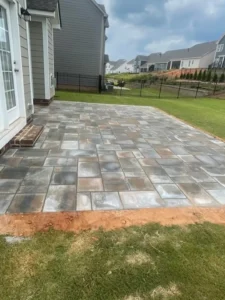
D & L Landscape Pros often evaluates grading around hardscapes and stonework projects to prevent future settling. When slope directs water toward hardscapes, it softens soil beneath them.
Fixing grading protects both the yard and the structures within it.
Sign #6: Large Sections of Lawn Stay Soggy
If certain areas of your yard feel soft days after rain, grading may be preventing water from dispersing evenly.
Clay soil holds moisture longer than other soil types. Without proper slope, water has nowhere to go.
In some cases, grading corrections reduce or eliminate the need for additional drainage systems. In others, grading sets the foundation for effective drainage.
The key is diagnosing whether the issue is slope, soil, or both.
Sign #7: Your Yard Feels Uneven Underfoot
Minor dips can sometimes be leveled. But widespread unevenness often indicates improper grading during original installation.
Homeowners frequently search for solutions after noticing:
- Trip hazards
- Mower scalping
- Visible waves in the lawn
If you’ve already explored issues like uneven ground, you know surface leveling doesn’t solve structural slope problems.
Professional grading reshapes the entire yard to restore proper contour.
Why Topsoil Alone Doesn’t Solve Grading Issues
Adding topsoil addresses volume — not direction.
Grading focuses on:
- Elevation changes
- Slope consistency
- Water flow patterns
Simply piling soil into a low area doesn’t correct the angle at which water moves across your property. In fact, adding soil without compaction can create future settling.
D & L Landscape Pros uses professional equipment to reshape and compact soil correctly before finishing with turf restoration.
What Professional Grading Involves
When you hire D & L Landscape Pros for grading, the process may include:
- Evaluating current slope and water flow
- Identifying high and low points
- Removing excess soil where needed
- Adding and compacting fill material strategically
- Ensuring proper drainage away from structures
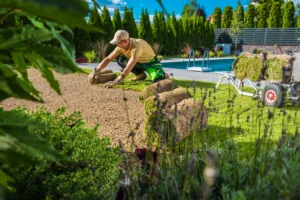
After grading, lawns can be restored through professional sod installation for a clean, uniform finish.
This ensures the yard not only drains properly but also looks polished.
When Grading and Drainage Work Together
Sometimes grading alone solves the issue. Other times, grading prepares the yard for effective drainage improvements.
If water volume is high due to runoff or roof discharge, grading adjustments may be paired with drainage enhancements. The goal is to create a system where water flows intentionally rather than randomly.
D & L Landscape Pros evaluates both slope and drainage before recommending a solution.
Why Local Expertise Matters
Grading in North Carolina isn’t the same as grading in sandy regions.
Clay soil behavior, heavy rainfall patterns, and neighborhood construction methods all influence how yards settle.
D & L Landscape Pros understands Monroe and South Charlotte soil conditions and builds grading plans tailored to local realities — not generic formulas.
This localized experience prevents repeat problems and long-term instability.
Don’t Ignore the Warning Signs
Grading problems rarely fix themselves. Over time, minor slope issues can lead to:
- Foundation concerns
- Hardscape damage
- Increased erosion
- Persistent drainage complaints
If you’re repeatedly adding soil without seeing lasting results, it’s time for a professional evaluation.
D & L Landscape Pros provides grading and landscape correction services throughout Monroe, South Charlotte, Matthews, Mint Hill, and surrounding areas.
Schedule your free estimate and get expert guidance on whether your yard needs grading — not just more topsoil.